
Finding Mainely Cards in the Golden Age of Postcards
- Shannon Cyr

- Jun 18
- 6 min read
Updated: Jul 27
Building Mainely Cards raised a simple question: where did we fit in the greeting card industry? I expected to find the answer in today's marketplace. Instead, I found it more than a century in the past.
When we started building Mainely Cards earlier this year, I spent a surprising amount of time researching the greeting card industry. Every decision, from pricing to positioning, depended on answering one seemingly straightforward question: where do we fit? It seemed like a simple question with a clear answer. After all, we knew exactly what we were making.
Our cards begin with our original artwork. Every illustration is reimagined as a paper design. We spend hours deciding what should become its own layer, refining shapes, adjusting proportions, testing colors, and experimenting with different papers until the design feels balanced, dimensional, and true to the original idea. We precision-cut individual pieces of paper and hand-glue them to thick, white professional-grade cardstock to create a dimensional greeting card you can see and feel. We intentionally leave every card blank inside because we believe the most meaningful part of the card comes from the person who chooses it, writes inside it, and shares it with someone else.
Simple enough, right?
Turns out, the more I looked, the more complicated things became. I found designers, handmade card makers, quilling artists, layered paper artists, and artists using traditional printers to reproduce their illustrations. Each represented a different piece of what we do, but I couldn't find another company that brings all of those disciplines together in a single greeting card like we do.
Surely someone else was doing this?
That question sent me deep into a research rabbit hole. I expected to find our place in today's online marketplace. Instead, I found the closest parallel more than a century in the past. That's when I discovered the Golden Age of Postcards.
The Golden Age of Postcards
The period I stumbled into wasn't just another chapter in greeting card history. It was one of the most remarkable eras of paper communication ever to take place in America.
Between about 1900 and 1915, postcards became part of everyday life. Millions of Americans embraced them as a new way to stay in touch, sending illustrated greetings for birthdays, holidays, vacations, congratulations, and everyday moments. As mailboxes filled, so did decorative postcard albums. Collecting favorite postcards became a popular pastime, making postcards as much a hobby as a way to communicate.

The Need to Stay Connected
At the turn of the twentieth century, America was changing rapidly. The Second Industrial Revolution was reshaping nearly every aspect of daily life. New industries created jobs in growing cities, drawing millions of people away from the communities where they had grown up. At the same time, waves of immigration brought newcomers from around the world, and an expanding railroad network made it easier than ever for people to move in search of opportunity.
For many families, those opportunities came with a tradeoff. Parents, children, siblings, and friends increasingly found themselves living in different towns, different states, or even on opposite sides of the country. Staying in touch became both more important and more challenging.
The way most people communicated across distance was handwritten letters. They carried family news, important announcements, and detailed correspondence. Writing a proper letter required time, careful penmanship, and a degree of formality that made them better suited for significant news than everyday conversation. Telephones existed, but they were expensive, uncommon in most homes, and long-distance calls remained a luxury.
The country was ready for a faster, simpler, more affordable way to stay connected.
What Made the Golden Age Possible
The Golden Age of Postcards wasn't the result of a single invention. It emerged because three developments arrived at exactly the right moment: one-cent postcard postage, advances in commercial printing, and an expanding railroad network that delivered mail quickly across the country.

One-Cent Postcard Postage (1898)
In 1898, Congress authorized privately printed postcards to be mailed for just one cent. Adjusted for inflation, that's roughly thirty-five cents in 2026. For the first time, nearly anyone could afford to send a handwritten greeting. Birthdays, holidays, congratulations, and simple notes of friendship suddenly became inexpensive enough to send regularly.
Advances in Commercial Printing (1903–1915)
Commercial printing was undergoing a revolution. Advances in chromolithography, embossing, metallic inks, and color printing allowed publishers to produce richly illustrated postcards on an unprecedented scale. What had once been expensive specialty printing became affordable enough for millions of colorful holiday and everyday greetings to roll off the presses.
Railroads and the Postal Service (1864–1915)
An expanding railroad network and an increasingly efficient postal service helped transform the way Americans communicated. Beginning in 1864, Railway Mail Service cars sorted mail while trains traveled across the country, dramatically reducing delivery times. By the early twentieth century, many cities received multiple mail deliveries each day. A postcard mailed in the morning could sometimes arrive before dinner.
Postcards Changed the Way People Communicated
In many ways, the United States Postal Service became America's first social network. Postcards made brief, informal communication socially acceptable.

Now, a birthday wish, holiday greeting, note of congratulations, or a simple "thinking of you" message no longer required several pages of carefully composed correspondence. A few words were enough.
One Small Problem
As popular as postcards had become, they still had one major limitation: space.
Postcard writers had only a small area on the front of the card for their message. If the message didn't fit in the space provided, the only option was to write around the artwork, squeezing words into every bit of empty space possible.

The reason becomes clear when you turn the card over.
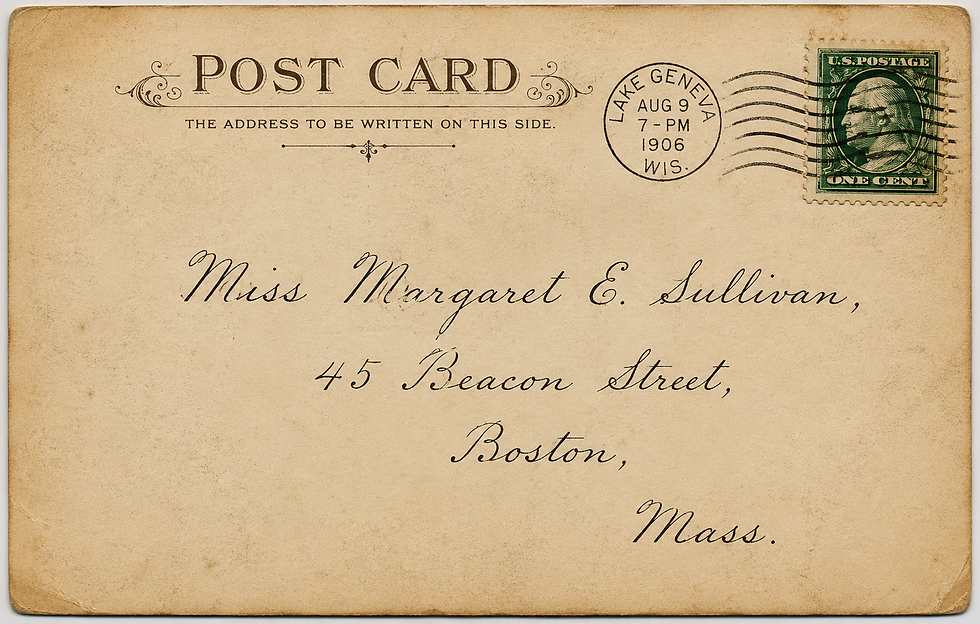
Postal regulations reserved the entire back of the postcard for the recipient's address. Writing a message on this side could result in the postcard being rejected or being charged at the higher letter-postage rate.
A Brilliant Design Change
In 1907 a remarkably simple idea changed everything. The United States adopted the divided-back postcard, dividing the back of the card into two sections: one for the address, and one for a handwritten message. Writers finally had enough space for their messages and artists had the entire front of the postcard as their canvas.
The examples below show how the same postcard design would have appeared before and after the introduction of the divided-back postcard in 1907.
AI-generated historical illustration of a typical pre-1907 postcard. Before the adoption of the divi AI-generated historical illustration of a divided-back postcard introduced in the United States in 1
It seems like a small design change today, but it solved two problems at once. People sending postcards finally had enough room for their messages, and artists finally had the entire front of the postcard as their canvas. With more space for both words and artwork, postcards became easier to use, more beautiful to receive, and even more popular than before.
A National Craze
By the early twentieth century, sending, receiving, and collecting postcards was a national craze. No holiday seemed too large or too small for a postcard. Christmas, New Year's Day, Valentine's Day, Easter, Thanksgiving, Halloween, St. Patrick's Day, patriotic holidays, and countless regional celebrations all became opportunities to send postcards. And, publishers didn't stop with holidays. They created postcards for birthdays, graduations, congratulations, sympathy, friendship, travel, and everyday correspondence. Local printers produced postcards featuring Main Streets, churches, landmarks, festivals, newly constructed buildings, and even breaking local news.
If people had a reason to connect, someone was ready to print a postcard for it.
When Paper Became Art
As postcards grew in popularity, publishers competed to make them more beautiful.
Illustrations grew larger, more detailed, and more elaborate. Embossed papers, metallic inks, decorative borders, vibrant color printing, and intricate illustrations transformed inexpensive postcards into miniature works of art. Many were designed to feel like keepsakes rather than disposable mail.
Artists filled postcards with flowers, snowy villages, birds, children, holiday scenes, patriotic imagery, and whimsical illustrations that made even a short note feel special.
The postcard had evolved from a convenient way to communicate into a small work of art that would be written in, sent, and kept.

Many postcards found a place on mantels, were tucked into scrapbooks, or found their way into keepsake boxes long after the holiday had passed. The artwork made them beautiful. The handwritten message made them personal.
The Golden Age of Postcards eventually came to an end when World War I disrupted the international printing industry, postage rates increased, and folded greeting cards gradually replaced postcards for many occasions.
The era may have ended, but its influence can still be seen in today's greeting cards.
A Golden Time for Greeting Cards
The more I learned about the Golden Age of Postcards, the more familiar it felt. The artwork, the layers, the texture, the intention behind every design—all of it echoed what we are building today.
Like those early postcards, our greeting cards begin with original artwork and take shape through layered paper design. Their dimension, texture, and touch of sparkle celebrate the beauty of paper. Once someone adds a handwritten message and shares the card, it becomes something worth keeping.
In the end, I realized Mainely Cards is part of a long tradition of people who have used paper to share both art and connection.
Mainely Yours,
Shannon


