
The Maine Lobster Boat: Built to Work

From early lobster traps to gasoline engines and modern working boats, discover how generations of practical ingenuity shaped Maine’s distinctive lobster boat and inspired our own paper interpretation.

A Maine Lobster Boat
A few summers ago, Michael and I spent an evening cruising the Saco River with friends. We spent a couple of hours winding along the water, and as evening settled in, the sky turned pink and orange with the setting sun. As we cruised past Camp Ellis, we passed an anchored lobster boat. Against that sky, its distinctive shape caught my attention, so I pulled out my phone and took a photo.

Looking at this photo, I couldn't help but think about the first time I saw a lobster boat. We were standing outside DiMillo's On the Water in Portland when I spotted one among the boats along the waterfront. I remember thinking, What kind of boat is that? It looked unlike any boat I'd seen before.
Boats weren't unfamiliar to me. My family had power boats, and we spent plenty of time on the water, cruising the Sacramento River and skiing lakes like Sly Park and Shasta. I had spent some time on fishing boats, paddleboats, riverboats, and ferries. I'd sailed in Southern California and Florida and seen all kinds of boats while traveling in Italy. But this was something entirely different.
Why do lobster boats look the way they do? What makes them so different from the other boats I knew?
Let's find out.
To understand how the lobster boat got its distinctive shape, we first need to understand the work it was built to do.
Before the Lobster Boat
Maine's commercial lobster fishery began to take shape in the 1820s. Before that, lobster wasn't the catch driving Maine's fishing economy. That honor belonged to cod. Lobsters were plentiful along the coast, but they were still largely a local resource, used for food, bait, and even fertilizer. The lobster industry that would eventually become synonymous with Maine hadn't arrived yet. And neither had the lobster boat.
At first, fishermen caught lobsters from the same small boats they used for other work along the coast. Their gear was simple, and not all that effective.
Before wooden lobster traps were invented, fishermen used baited hoop nets in shallow coastal waters. These early traps consisted of a large hoop with netting attached underneath and bait suspended over the center. Lobsters crawled onto the net to feed, but there was nothing to keep them there.

Fishermen had to check the nets frequently and haul them before the lobsters finished eating all the bait and wandered off.
A Better Way
Eventually, fishermen began using wooden lath pots designed to keep the lobster inside after it entered. These early traps had a rounded top made from wooden laths and funnel-shaped openings at the ends.

A lobster could climb through the narrowing funnel toward the bait, but getting back out wasn't nearly as easy. Unlike the hoop nets, the new traps didn't need to be watched constantly. Fishermen could leave them in the water and return later to collect their catch.
The wooden traps worked, but they didn't make lobstering easy. Every pot still had to be tended individually. Fishermen moved from one to the next, hauling each trap aboard, removing the lobsters, adding fresh bait, and returning it to the water.
According to C. H. Cobb in The Lobster Fishery of Maine, lobstering was typically a two-man operation.

One fisherman worked the pots and the other handled the boat, keeping it where it needed to be as his partner worked the traps. Along Maine's rocky, unforgiving coast, with wind, waves, currents, and changing weather to contend with, that was no small job.
Around 1865, another change made the work more efficient. Instead of setting each pot on its own, fishermen began setting them on trawls, connecting several pots along a single line on the ocean floor. This allowed them to move from one connected pot to the next as they worked the line.
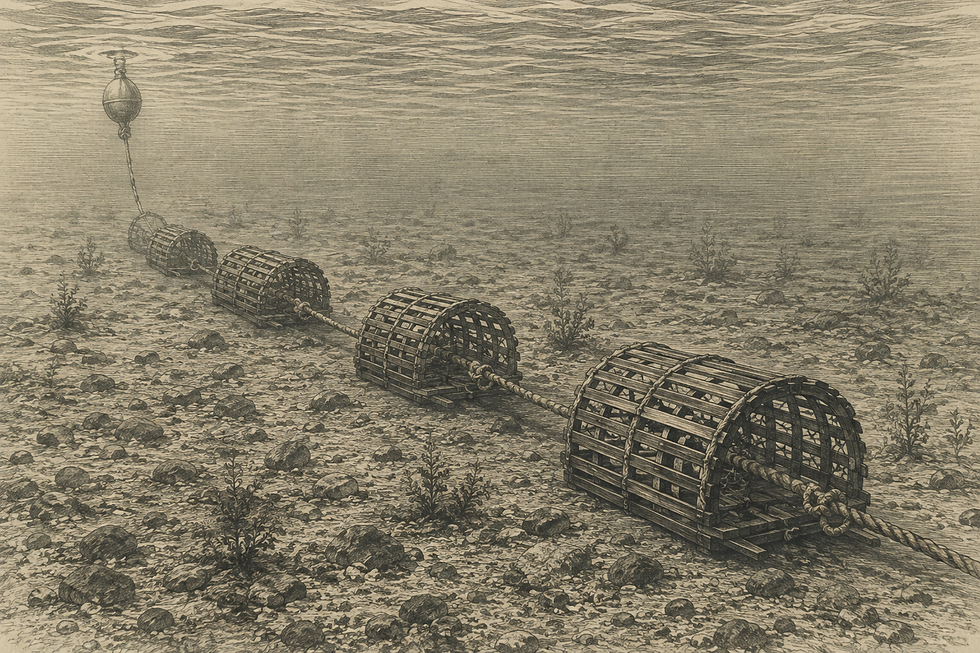
Fishermen could set more pots this way, and a job that had previously required two men could now be done by one.
Early Boats of the Lobster Fishery
All of these changes affected more than how lobsters were caught. They also changed what fishermen needed from their boats.
The Dory and the Peapod
In the early days of the fishery, fishermen used the small working boats already common along the coast. One was the dory, a versatile boat used for everything from fishing to hauling people and supplies. Dories weren't lobster boats. They were workboats that happened to be used for lobstering, too.
Then, around 1870, something different appeared on North Haven: the peapod. Unlike a traditional Dory, the peapod is small, double-ended boat was particularly well suited to inshore lobstering. Its shallow draft allowed fishermen to work around Maine's rocky ledges, and because both ends were pointed, it could be rowed easily in either direction.

The peapod worked particularly well for inshore lobstering, but it had its limitations. It was a small, open boat powered primarily by the fisherman at the oars. There was only so much room for traps, bait, and the day's catch, and its shallow draft and maneuverability were most useful close to shore. As the lobster fishery expanded and fishermen began working more gear farther from shore, they needed more from their boats.
The Friendship Sloop
By the late 1800s, larger sailing vessels known as Friendship sloops had become important working boats in Maine's lobster fishery.

Named for Friendship, Maine, where many of these ships were built, Friendship sloops offered fishermen something the little peapod couldn't: more space.
A bigger boat meant more room for traps, bait, and catch, along with the ability to work farther from shore in more exposed waters. Their sailing rigs could also be handled by a small crew, making them practical working boats for fishermen tending strings of lobster pots.
The Friendship sloop solved some of the peapod's limitations, but it still depended on the wind. Fishermen could carry more gear and travel farther from shore, but sailing from one string of pots to the next wasn't always quick or predictable. Wind direction and conditions still determined how easily they could move around their fishing grounds.
Boats Powered by Something New
By the early 1900s, a new technology was beginning to change Maine's lobster fishery: the gasoline engine.
At first, boatbuilders adapted existing workboats to accommodate the new engines. Small marine engines could be fitted into the boats fishermen were already using, freeing them from relying entirely on oars and wind. With engines, they could travel farther, fish for longer seasons, and move more predictably from one string of pots to the next.
As engines became more powerful, the boats began changing around them. Hull shapes, sterns, shelters, and working layouts evolved as builders looked for ways to make powered boats faster, more stable, and better suited to carrying traps and catch.
One of the boatbuilders helping push this evolution forward was Will Frost. Originally from Nova Scotia, Frost eventually established himself in the Beals Island and Jonesport area of Downeast Maine. He was fascinated by the possibilities of the gasoline engine and began developing hulls designed to take advantage of the new technology. His first powerboat, Toronto, launched in 1906.

Over the following decades, Frost became known for building fast, narrow boats that could carry heavy loads without sacrificing speed. His lobster boats had high bows to meet the sea and lower sides toward the stern, making it easier for fishermen to haul their pots aboard. Early designs had rounded torpedo sterns, with square sterns appearing later and providing more working space. The simple shelters used on earlier boats also evolved into more substantial cabins and wheelhouses.
Frost wasn't working alone. Boatbuilders throughout Maine were adapting their designs as engines improved and the demands of lobstering changed.
Built for the Work
By the 1920s, powered lobster boats were becoming increasingly specialized. Lobstermen worked more traps, carried heavier loads, and traveled farther along the coast. New technology continued to expand what their boats could do.

Through all of those changes, the boat remained organized around the work. The wheelhouse stayed forward, leaving a large open deck for hauling and handling traps. The high bow provided protection in rough water, lower sides kept fishermen closer to the water as they brought their gear aboard, and wide sterns created more room for traps, lines, bait, and catch.
From Boat to Paper
By the time I was ready to create a paper lobster boat, I understood so much more about the silhouette that had caught my attention in the first place. Now I knew why it looked the way it did.
Then came the design question: What color should my lobster boat be?
As it turns out, pretty much any color I wanted. Once I started looking at boats along Maine's working waterfronts, I found red ones, blue ones, green ones, yellow ones, and just about everything in between. The owner gets to make that choice, which meant I did, too.
I immediately knew mine would be red. The lobster boat I'd photographed in Camp Ellis was red, and when I pictured my own paper version, that's the boat I saw.

Share a Piece of Maine
Send a little piece of Maine with our handcrafted Lobster Boat at Sea card and share it with someone who loves the coast.
Built for connection. Made from paper and glue.
Mainely Yours,
Shannon


