
The Right Tree: Redesigning the Pine and North Star Card

A look inside the evolution of the Pine and North Star card, from one of my earliest paper designs to an original Eastern White Pine inspired by Maine's first state flag.
One of the First Cards
The Pine and North Star is one of the oldest designs in the Mainely Cards collection.
I made the first version in February 2025, when I was beginning to move from Sizzix dies to a Cricut cutting machine and exploring what I could create from paper. Back then, Mainely Cards didn't exist. I was making greeting cards to donate to care communities and the Cricut opened up possibilities I didn't have with traditional dies. Instead of choosing from the shapes I owned, I suddenly had access to thousands of designs I could cut from paper and turn into cards.
Three of those early cards would eventually become the foundation of the Maine collection: a lighthouse, a lobster, and a pine tree. I didn't create the artwork for those first cards. Like many people learning to use a Cricut, I started with designs created by other artists and available through Cricut Design Space.

The pine tree was a full, triangular evergreen made from dark green paper, with tiny swishes of lighter green paper layered on top to create the appearance of branches. I wasn't thinking about what species of pine it represented, I was just learning how to make a tree card.
Over the next several months, I made a lot more cards and experimented with other tree designs. I tried different shapes, layers, and styles, including a much simpler version made from three evergreen silhouettes. Somewhere in that experimentation, I found a tree design both Michael and I really liked.
It used a green paper tree layered over black, with openings in the green paper that allowed the black layer beneath to become part of the branches and create the tree's dark bark. Instead of gluing tiny pieces of paper to add detail to the tree, the layers themselves created it. I loved the effect.
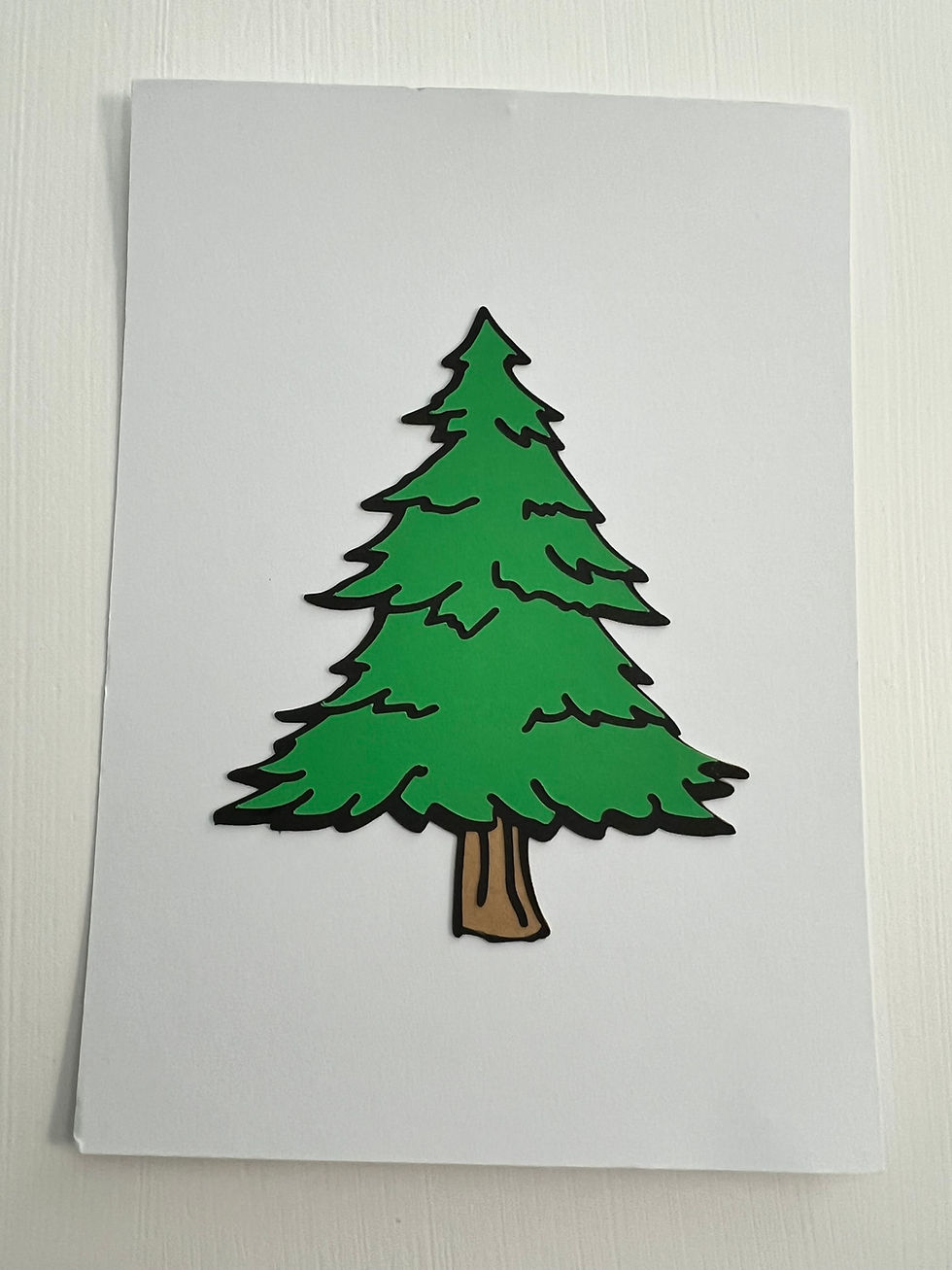
It became our pine tree. I started using it for Maine pine tree cards without giving much thought to it. I was paying for a Cricut Access subscription, and the artwork was available for me to use under Cricut's Angel Policy.
The Rules Changed
In September 2025, Cricut changed its Angel Policy, which determines how images from Cricut Design Space can be used. I wasn't selling my cards. I was making them to donate to our nonprofit, Wicked Good Cards, so initially I thought the change in policy wouldn't impact me.
I was wrong.
Under the new policy, I couldn't continue using Cricut Access artwork on the cards I was donating. The policy didn't distinguish between a card sold to a customer and one I made to donate. If I wanted to keep making and donating cards through the nonprofit organization, I had to find a different way.
Michael encouraged me to design my own artwork. Hmm. I had always drawn, painted, doodled, and made things, but it had never occurred to me to design images specifically to be constructed from paper.
I wasn't sure I could do it. I was still learning the basics of working with a Cricut: which papers cut cleanly, how small I could make a piece, how to weed intricate designs without destroying them, and how to assemble all those pieces into a finished card. Now I also needed to learn how to draw an image, break it into individual pieces and layers, and design those pieces so they could actually be cut from paper, assembled by hand, and still look like the thing I had drawn without requiring 500 teeny tiny pieces.
But what choice did I have? Abandon the nonprofit five months after establishing it? No. That wasn't an option. So, I did what any determined person would do. I learned.
I Changed
Over the next few months, I taught myself how to design for paper. I experimented with simple shapes and more detailed designs, learned how to use negative space to create details, and started thinking about an image as separate pieces instead of a single drawing.

I learned where pieces needed to overlap, where paper needed more structure to survive the cut, and when a detail that looked great on screen became impossible once it was reduced to the size of a greeting card. I made a lot of mistakes, cussed, adjusted the artwork, and tried again.
The cards from this period are a good record of how I was learning. Some ideas lasted for a single card. Others led to another version, and then another.

I created a full evergreen with a green top layer over black paper, using openings throughout the tree to reveal the black beneath and create the branch detail. I added a brown trunk, a blue North Star, and started experimenting with different greens, proportions, and sentiments.
By the end of November, I had a Pine and North Star design both Michael and I liked enough to keep so tree was slated to be part of the card as Mainely Cards launch for the Pine Tree and North Star greeting card.
Understanding the Symbol
In May 2026, as I was researching the history of Maine's original 1901 state flag for a Studio Stories Behind the Cards post, The Pine Tree and North Star: A Maine Symbol Through Time, I took a closer look at the pine tree and North Star as symbols vs elements of a card design.
I learned that the pine tree on Maine's original flag wasn't a generic evergreen. It was an Eastern White Pine, Maine's state tree and a species deeply connected to the state's history. Its tall, straight trunks made it especially valuable for shipbuilding and maritime trade, and the tree had become a symbol of Maine long before it appeared on the 1901 flag.
The more I learned about the Eastern White Pine, the more obvious the problem with my card became. I had spent months learning how to design and build my own paper tree, but it was a triangular evergreen. It worked as a tree. It worked in paper. It just wasn't an Eastern White Pine.
My first instinct was to leave it alone. The card wasn't intended to be a reproduction of the 1901 flag, and I had plenty of room for artistic interpretation. I wasn't the only one interpreting the tree that way. I had seen contemporary versions of the Pine and North Star that reduced the tree to a simple graphic evergreen, far removed from the shape of an actual Eastern White Pine. The symbol was still immediately recognizable: pine tree + North Star = Maine.
I tried to make the same argument for my card. My tree was an evergreen. There are evergreen trees in Maine. The North Star sat above the evergreen tree. Together, they clearly referenced a pine tree and the North Star. No one said I had to create a botanical illustration for the design to work.
Except me. I knew the story behind the tree, and every time I looked at my design, I knew it wasn't the right tree for the story the card was trying to tell.
Designing an Eastern White Pine
Once I stopped arguing with myself, I had a new problem: I needed to figure out how to make an Eastern White Pine from paper.
Unlike the full, triangular evergreen I had been using, mature Eastern White Pines often have long exposed trunks, irregular branches, and much of their foliage concentrated toward the top. That distinctive shape created a compositional problem. With the North Star already above the tree, nearly all of the visual weight ended up at the top of the card.
I experimented with the proportions and placement of the branches, trying to find the balance between what made the tree recognizable and what worked on the card.

My early versions had some pretty wild lower branches. I was trying to capture the irregular growth of an Eastern White Pine, so I deliberately avoided making the tree perfectly symmetrical. I changed the length, direction, and placement of the branches from one prototype to the next, trying to make the tree feel more organic.
I also experimented with small cutouts in the branches to add detail, but my eye kept going to the openings instead of the tree itself and the green glitter paper. Michael suggested bringing more symmetry to the branches, so I removed the cutouts, smoothed the branch shapes, and adjusted the proportions until the overall shape formed a looser triangle.
In the final version, I smoothed the branches, removed the cutouts, and brought the overall shape closer to a triangle. The branches were more symmetrical, but the exposed trunk and separated tiers of branches gave it the character of an Eastern White Pine.
The Eastern White Pine Tree and North Star Card


The Right Tree
The redesigned Eastern White Pine is now the tree you'll find on our Pine and North Star card.
I'll admit, I'm proud of this little tree. It represents so much of what I've learned as a paper artist: how to study something closely, understand what makes it recognizable, and translate those details into layers of paper. The exposed trunk, open spaces, and glittering whorls of branches make it an Eastern White Pine, but the balanced triangular shape lets it work beautifully on the card.
More importantly, it feels true to the symbol that inspired it. The Pine and North Star has represented Maine since it appeared on our first state flag in 1901. I wanted my version to honor that history and still feel like my own artwork.
I think I did right by Maine.
Mainely Yours,
Shannon


